



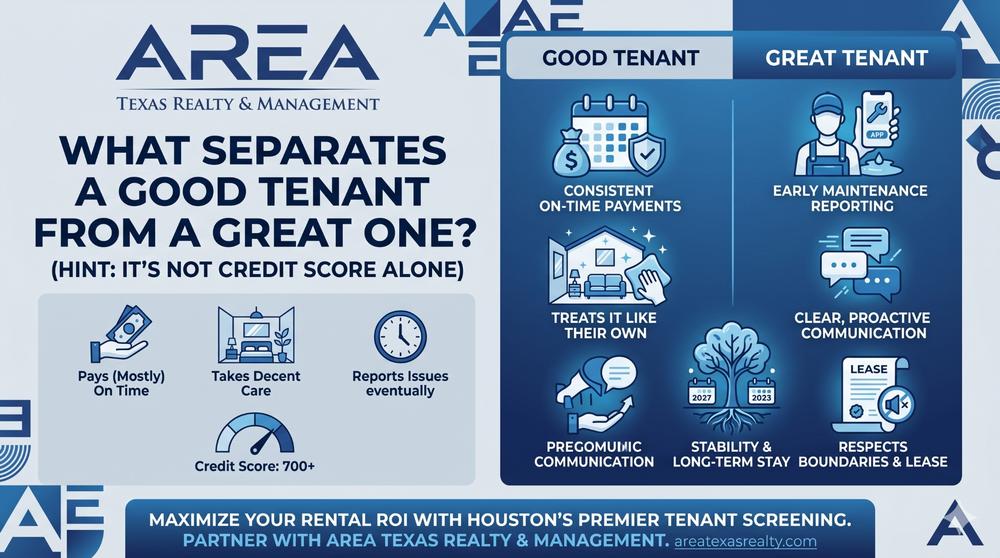
If you’ve owned a rental property for more than five minutes, you already know this: not all tenants are created equal.
Some pay rent on time. Mostly.
Some take decent care of the place. More or less.
And then there are those rare ones. The ones you almost forget about because… nothing goes wrong.
No late payments. No complaints. No surprises during inspections. They just quietly make your life easier.
So what’s the difference?
Because it’s not just credit score. Not even close.
Let’s Start With the Obvious (and Slightly Misleading) Metric
Credit score gets a lot of attention. And to be fair, it matters.
A higher score usually means:
Better financial habits
Lower risk of missed payments
More predictable behavior
But here’s the thing.
A 750 credit score doesn’t tell you:
If they’ll report maintenance issues early
If they’ll treat your property like a home or a hotel
If they’ll renew their lease or disappear after 12 months
In other words, it tells you how they handle money. Not how they handle your property.
And that’s where things get interesting.
Trait #1: Consistency (The Quiet Superpower)
Good tenants pay rent on time.
Great tenants make it boring.
You don’t have to follow up. You don’t check your account on the 3rd wondering if something’s off. It just… happens.
Consistent tenants:
Pay on time every month
Communicate early if something changes
Stick to lease terms without needing reminders
It sounds simple. It is simple. But it’s also rare enough to matter.
Trait #2: They Report Problems Early (Instead of Hiding Them)
This one saves you thousands.
A small leak under the sink. A strange noise from the AC. A minor crack somewhere.
A good tenant might ignore it. Or mention it casually weeks later.
A great tenant flags it early. Sometimes immediately.
According to insights shared by WeLease, early maintenance reporting is one of the biggest drivers of lower long-term repair costs. Small issues stay small when someone speaks up.
And yet, many tenants don’t.
Some don’t want to “bother” you. Others assume it’s not urgent. Either way, delays turn $200 fixes into $2,000 problems surprisingly fast.
Trait #3: They Treat the Property Like It’s Theirs (Even Though It’s Not)
You can usually tell within the first inspection.
Great tenants:
Keep things clean
Avoid unnecessary damage
Handle small day-to-day upkeep
They’re not perfect. No one is. But there’s a baseline level of care that shows.
Good tenants live in the property.
Great tenants take care of it.
There’s a difference. You feel it.
Trait #4: Communication That Doesn’t Feel Like a Chase
You shouldn’t have to track down your tenant to get a response.
Great tenants:
Reply within a reasonable time
Communicate clearly
Don’t disappear when something needs attention
It sounds like a low bar. But if you’ve ever waited days for a reply about something important, you know it’s not always a given.
This is one area where experienced property managers tend to set the tone early. Expectations are clear. Communication stays structured. Everyone knows how things work.
Trait #5: Stability (They Stay Longer Than You Expect)
Turnover is expensive.
Between:
Vacancy loss
Cleaning and repairs
Marketing the property
Screening new applicants
Even a short gap can eat into your returns.
Data from the National Apartment Association suggests turnover can cost 1.5 to 2 months of rent on average.
Great tenants reduce that risk simply by staying.
They renew. They settle in. They don’t treat your property as a temporary stop.
Trait #6: They Respect Boundaries (and the Lease)
This one’s subtle but important.
Good tenants follow the rules when reminded.
Great tenants don’t need reminders.
They:
Stick to occupancy limits
Follow pet policies
Respect noise and community guidelines
No awkward conversations. No “just this once” exceptions turning into patterns.
So Why Is It So Hard to Find Great Tenants?
Because most screening focuses on what’s easy to measure.
Income. Credit. Background checks.
All important. But incomplete.
What’s harder to measure:
Behavior patterns
Communication style
Long-term reliability
That’s where experience comes in.
Teams like Wurth Property Management often emphasize a more holistic screening process, looking beyond numbers to identify tenants who are more likely to perform well over time, not just qualify on paper.
And that’s really the goal.
A Quick Reality Check (Because It Helps)
You’re not looking for a perfect tenant.
You’re looking for:
Predictability
Low maintenance (the good kind)
Long-term stability
Great tenants aren’t flashy. They’re not memorable in a dramatic way.
They’re the ones you barely think about because everything just works.
What This Means for You as a Property Owner
If you’re self-managing, this is where things can get tricky.
Because spotting these traits:
Takes time
Requires pattern recognition
Involves a bit of instinct
And sometimes, you only realize what you had… after they leave.
This is also why many owners eventually lean on property managers. Not because they can’t manage. But because finding and keeping great tenants is a skill in itself.
And it’s one that directly impacts your bottom line.
The Cost Difference (Good vs Great)
Let’s keep it simple.
A “good” tenant might:
Pay late once or twice
Miss early maintenance signs
Move out after a year
A “great” tenant:
Pays on time, every time
Helps prevent costly repairs
Stays multiple lease terms
Over 3–5 years, that difference can easily add up to thousands of dollars.
Quietly. Without you noticing at first.
So… What Should You Do Differently?
You don’t need to overhaul everything.
But you might:
Look beyond credit score during screening
Pay attention to communication early on
Ask better questions during the application process
Set clear expectations from day one
And if that still feels like a lot to manage, that’s normal.
Working with experienced property managers can help filter for these traits before a lease is even signed. It’s not just about filling a vacancy. It’s about filling it well.
When It Makes Sense to Get Help
If tenant turnover, maintenance surprises, or communication gaps keep showing up, it might be time to rethink your approach.
AREA Texas Realty & Property Management focuses on hands-on management, in-house maintenance, and structured tenant processes designed to reduce exactly these issues.
Not by chasing perfection. But by improving consistency.
And in this business, consistency tends to win.
FAQs
1. What makes a tenant “high quality” in Houston rentals?
A high-quality tenant pays rent on time, communicates clearly, reports issues early, and takes care of the property. Credit score alone is not enough.
2. Is credit score the most important factor in tenant screening?
No. While important, credit score doesn’t reflect behavior, communication, or how a tenant will treat the property.
3. How can landlords find better tenants?
Use a combination of screening methods, including rental history, communication during the application process, and references.
4. Do property managers help find better tenants?
Yes. Experienced property managers use structured screening processes to identify reliable, long-term tenants.
5. Why do great tenants save more money over time?
They reduce vacancy, prevent costly repairs, and minimize late payments, improving overall rental profitability.